
I lost my name twice, but never again!
I was a few days old when my parents went down to the registration office to get my birth certificate which was supposed to have the name,“Tabassom”, meaning “smile” and “happiness”.
Since that name did not appear in the government's official list of names (and yes, apparently a couple of decades ago in Iran, a book of eligible names was a real thing!) Government officials rejected it and asked my parents to choose a different one.
While my parents were discussing what to name me, my brother, who by the way was then 3 years old, suggested the name “Taraneh”! Since Taraneh is a less common Iranian name, my parents weren’t sure whether the officials would accept it. But spoiler alert, they did!
Flash forward to when we moved to Canada and I started to prepare myself to enter the Canadian education system, during the mighty high school era! We arrived in Canada around Christmas time, which meant I had to wait a few weeks before starting my academic journey.
During New Year’s Eve, I was attending a small gathering and meeting new people. As I tried to maintain a conversation with my almost non-existent English, someone turned to me and asked, “What name are you planning to use at school?” I gave them a look of confusion and asked what they meant by that. They continued to explain “Well obviously you need to pick a name that’s easier for everyone, otherwise they won’t be able to pronounce your name… We all had to do it.” And without missing a beat, they started to brainstorm names that I could use. As I was trying to comprehend why that was even necessary, they, very enthusiastically if I may add, announced, “Tara… yesss Tara would be perfect! You could be a Tara…That’s also an Iranian name and it suits you.” I nodded and agreed my new name would be “Tara”; after all, they simply wanted to make sure I fit in and have an easier time in my new school. No big deal, right?
Well…that was the beginning of a dual identity. I was Taraneh at home and with people close to me, and became Tara in school and in the outside world. I was learning a new language, adjusting to a new culture, and understanding a whole new education system, all while dealing with the immense pain that migration brings…And I changed my name for the comfort of the people around me.
At the time, not only was I grappling with my identity as I entered a new era of my teenagehood and a new society, but I also had to find a way to connect with my new name. A name that had no ties to my identity beyond a party-conversation that convinced me I needed a new name to be accepted into Canadian society… I must add that most people didn’t get that right either, as I got called Kara, Terra, or any variation that was not the same as the Persian pronunciation of the name Tara (Tuh-raw).
There’s a lot of power in your name, and there’s a lot of power in how you choose to be called. I know people who changed their last names to feel more authentic and aligned with who they are today. I also know people who changed their first names because their original name was tied to an identity that no longer existed. Some people even prefer to be called by a shorter version of their name because it feels more authentic to them or simply because they like it!
The common thread in all those scenarios is that the individual made the decision; that is, it came from an internal desire as opposed to an external pressure. At the beginning of my life, an arbitrary rule book forced my parents to let go of their first choice for my name- (I must admit, I do love the name Taraneh more, but that’s besides the point). I’m certain they felt alienated, with the government telling them their choice didn’t fit within their society. The pressure of needing to pick an easier name to fit in is even more arbitrary. Who can determine if a name belongs to a society? Who can say whether your authentic self belongs to the society you’re in? Our names are part of our identity. If someone questions whether your name belongs to a certain community, they also question whether you belong there.
I lived as Tara throughout high school, but by the time I got into university I could no longer carry this false identity around. In the course of three and a half years, I learned a new language, and went from powering through ESL classes to getting accepted to my chosen universities. I built new support systems for myself, and started to feel as though I belonged to this country. But I wanted to belong as me, Taraneh, not the anglicized version of me.
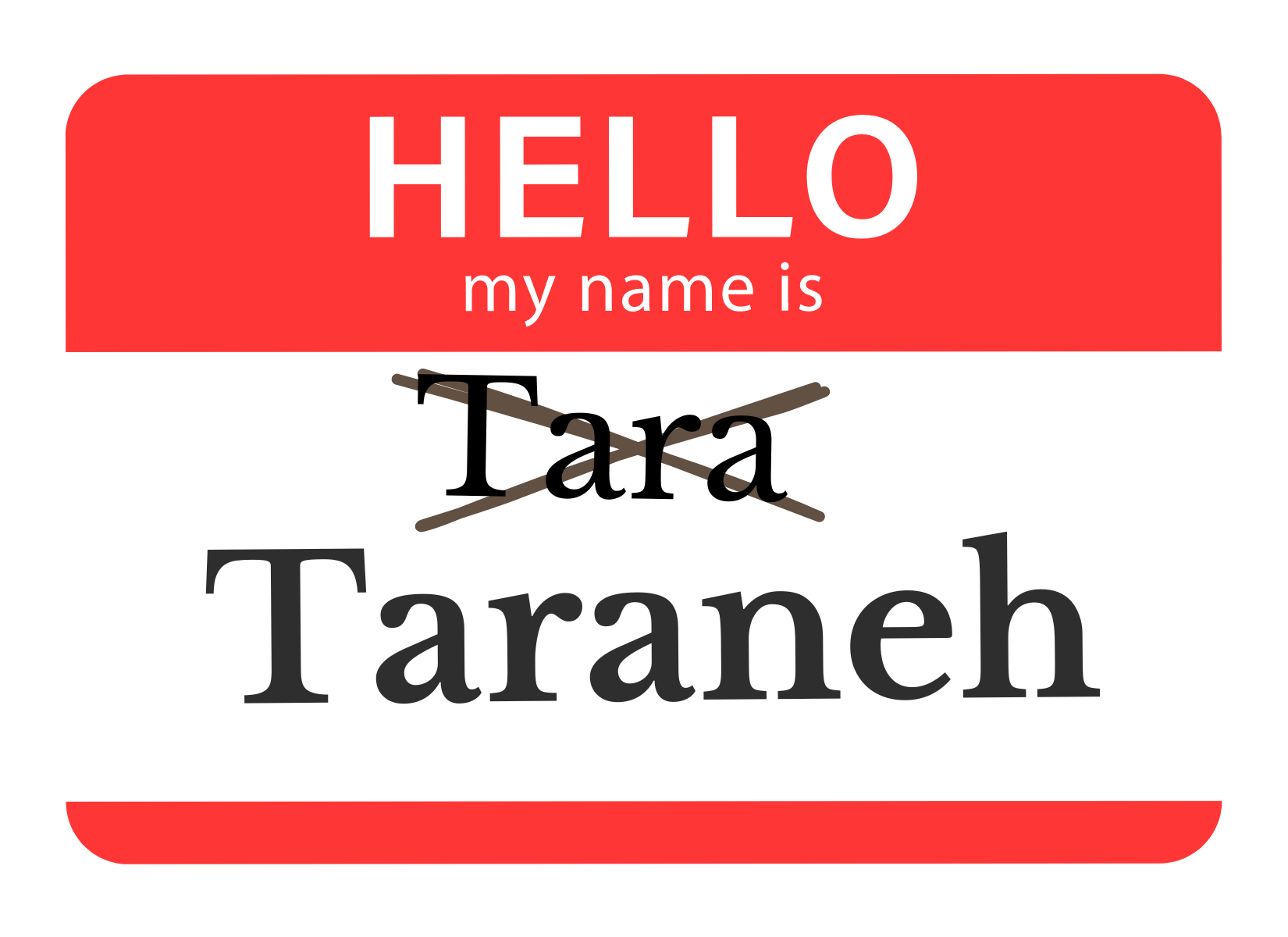
It was time for me to reclaim my name! I started university and didn’t give people any other option besides trying to learn my name. Did they mispronounce it constantly? Of course, but it was the effort that counted for me. I still mispronounce names and words, so I don’t expect anyone else to learn a new word, especially from a different language, and say it perfectly in the first try. But what shifted was the possibility of connection with the real me.
I admit, there have been some times when I caved in and allowed people to call me Tara, or made the choice to use the name “Melody” at Starbucks, which is the closest name to the meaning of Taraneh. What really matters is that I’m now more conscious of how my name relates to my sense of belonging. A nickname by a close friend makes me feel a sense of camaraderie and joy. It’s an indication of a deeper connection beyond labels and identity markers... Yet someone else addressing me with a nickname for their own comfort makes me feel alienated, and reminds me of the time I lost my name. Someone asking me whether I have a different name that I go by usually hears responses such as, “No, but feel free to ask me for the pronunciation as many times as you need” or “No, but as long as you’re trying I appreciate it.
If you ever felt the need to change your name to avoid inconveniencing others, or simply to have an easier time fitting in, ask yourself how that makes you feel. Is it taking away the opportunity for others to connect with the real you? What do you actually want to happen in order for you to have a real sense of belonging?
Remember, it’s okay to want people to learn your name. It’s not selfish! It’s who you are, and you shouldn’t feel the pressure to change it because it inconveniences people.
You can also gently remind them that you believe in their capacity to learn. We all sometimes need to be reminded that we have the capacity within us to become more inclusive and welcoming!